How to Contest a Will in NSW
November 6, 2026
When you buy a property in New South Wales, your solicitor or licensed conveyancer is the person who checks what you are agreeing to before you are bound, and who makes sure the property, the money and the title change hands correctly at settlement. The real estate agent is engaged by the seller, and under NSW Government guidance an agent “cannot change any part of the contract” (NSW Government, Contracts and deposits).
Several rules affecting buyers changed in 2025 and 2026, including a new standard contract, new strata disclosure, and new identity checks. This guide covers:
- what your solicitor checks before you sign
- the cooling-off period, and when it does not apply
- extra checks for strata apartments and townhouses
- transfer duty (stamp duty) and first home buyer relief
- what happens between exchange and settlement
Do I need a solicitor or conveyancer to buy a property in NSW?
Before a home is marketed for sale, the seller must have a contract prepared by “an Australian legal practitioner (lawyer/solicitor) or a licensed conveyancer” (NSW Government, Contracts and deposits). That contract is drafted for the seller. As the buyer, you need someone working for you.
The NSW Government describes three things your representative does before exchange:
- Reviews the contract and can negotiate changes on your behalf.
- Confirms any changes with the seller’s solicitor or conveyancer.
- Makes the inquiries and financial arrangements needed before you exchange.
Until contracts are exchanged, “the agreement is usually not binding,” and either side can change their mind (NSW Government, Contracts and deposits). Exchange is the point where both parties are bound. That is why the review needs to happen before exchange, not after.
A solicitor and a licensed conveyancer can both handle a standard purchase. A solicitor can also advise on legal issues that arise along the way, such as disputes over the contract, ownership structures (for example buying through a company, trust or self-managed super fund), or problems that come up before settlement.
What does my solicitor check in the contract before I sign?
A NSW contract for sale must come with certain documents. According to the NSW Government, these include (NSW Government, Steps to selling a property):
- A title search, the registered plan, and dealings on the title such as easements. An easement is a right for someone else to use part of the land, for example for drainage pipes.
- A drainage diagram, showing where the sewer lines run.
- A zoning certificate (often called a section 10.7 planning certificate) from the local council. It shows the zoning and planning controls that affect the land.
- A statement of your cooling-off rights in the prescribed form.
- A swimming pool certificate, if there is a pool. This does not apply to lots in strata or community schemes with more than 2 lots, or to off-the-plan contracts.
Your solicitor reads these documents together. The aim is to find problems that affect your use or the value of the property. Examples are an easement running where you plan to extend, a zoning that restricts what you can build, or a pool without a compliance certificate.
Your solicitor also reviews the special conditions. These are extra clauses the seller’s solicitor adds to the standard printed contract. They often shift risk to the buyer, for example by limiting your right to object to defects, charging higher interest if settlement is late, or requiring a larger deposit. Your solicitor can ask for these to be changed before you exchange.
The 2026 edition of the standard contract
The Law Society of NSW and the Real Estate Institute of NSW released a new edition of the standard Contract for the Sale and Purchase of Land in 2026. The 2022 edition could be used until 31 May 2026. From 1 June 2026 the 2026 edition is mandatory (College of Law, The new edition 2026 of the contract). Changes include a revised cooling-off notice, an updated inclusions list (for example solar batteries) and a new warning about anti-money laundering checks.
What is the cooling-off period, and should I waive it?
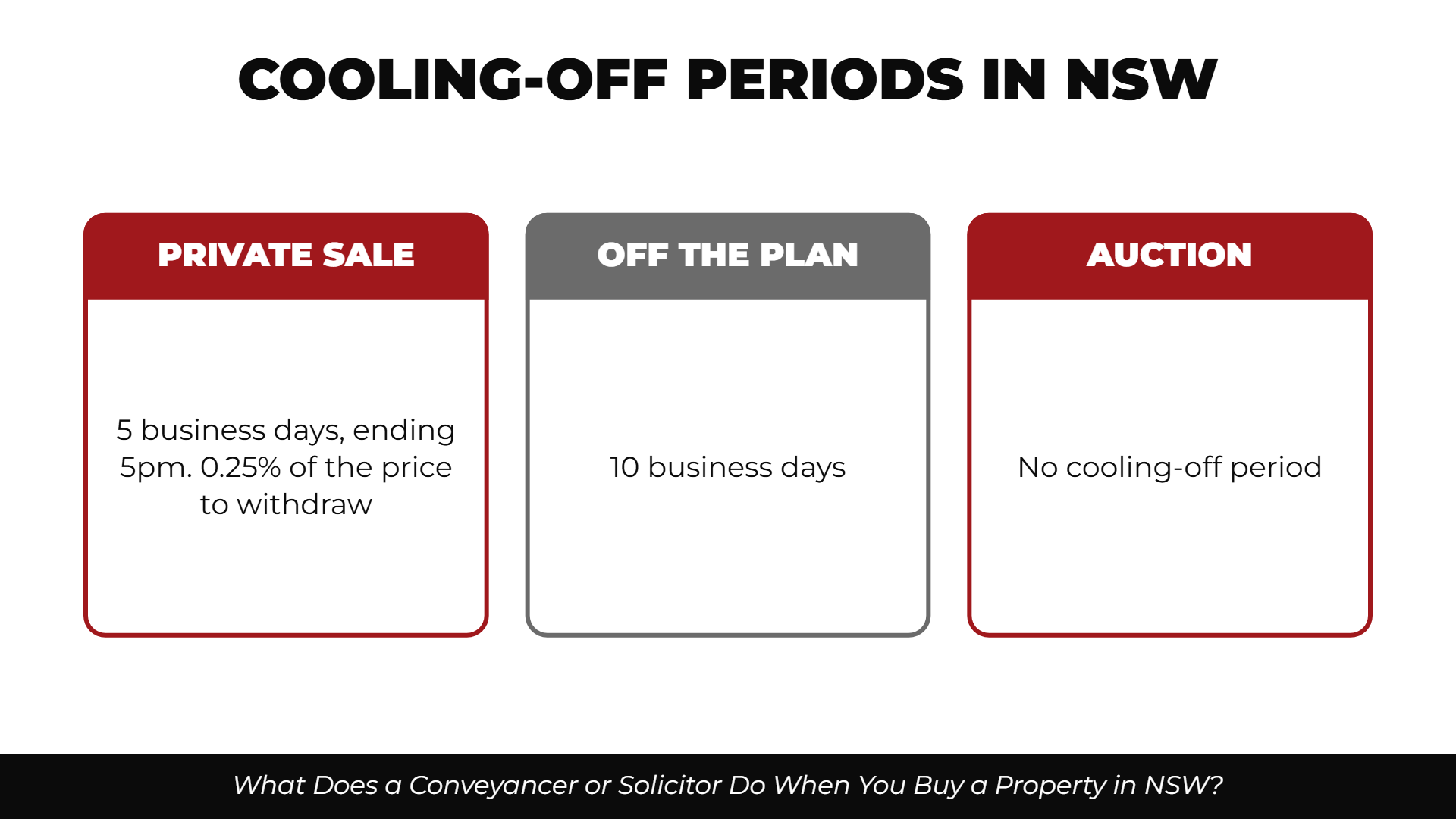
The cooling-off period is a short window after exchange when you can withdraw from a residential purchase. The rules are set out in the Conveyancing Act 1919 (NSW) and summarised by the NSW Government (Contracts and deposits):
- Length: 5 business days after exchange, ending “at 5pm on the fifth business day after the day of exchange.”
- Cost of withdrawing: you pay the seller 0.25% of the price. That “works out to be $250 for every $100,000.”
- Off the plan: a 10 business day cooling-off period applies.
- Auction: “A cooling-off period does not apply if you buy a property at auction.”
- Changing it: the period can be waived by giving the seller a “66W certificate,” or shortened or extended by written agreement.
A section 66W certificate is a certificate given by your solicitor or conveyancer. Once it is given, you have no cooling-off period and the contract is binding on exchange. Sellers often ask for one, so your solicitor will explain what you are giving up before signing it. Waiving cooling off means you need finance approval, a building and pest inspection, and (for strata) the strata checks done before you exchange.
Options to purchase: a 2025 change
Some sales are made through a put and call option. This is an agreement where the buyer has the right to buy (a call option) and the seller has the right to make the buyer buy (a put option) within a set time.
In BP7 Pty Ltd v Gavancorp Pty Ltd [2021] NSWSC 265, the Supreme Court of NSW held that a buyer still had cooling-off rights when the seller formed the contract by exercising a put option (Carroll & O’Dea Lawyers summary). Parliament responded with the Conveyancing and Real Property Amendment Act 2025 (NSW), assented to on 15 August 2025 (Parliament of NSW, Bill details). The NSW Registrar General states that contracts made when an option is exercised have “no cooling off period,” whether it is a call or a put option (Registrar General, Amendment Bill).
If you are offered an option deed instead of a contract, have it reviewed before you sign the option. Once the option is exercised, you will not have a cooling-off period on the contract.
The cooling-off notice form also changed. Contracts exchanged on and from 1 June 2026 must use the new form (Registrar General, Amendment Bill). If the notice is not given correctly, the College of Law notes that “a purchaser has the right to rescind at any time before completion” (College of Law, The new edition 2026).
I am buying a strata apartment or townhouse. What else should be checked?
Strata property (apartments, townhouses and villas in a strata scheme) carries an extra layer of risk. You are buying a lot and a share in the common property, and you will pay levies to the owners corporation. The owners corporation is the body made up of all the lot owners, which manages the building.
Before you exchange, the main check is a strata report (also called a strata inspection report). It is prepared by an inspector who reviews the owners corporation’s records: minutes, financial statements, levies, insurance, by-laws and correspondence. From 1 July 2025, the fee to inspect strata records rose to $60 for the first hour and $30 for each additional half hour, including GST (NSW Fair Trading, Guide to strata law changes).
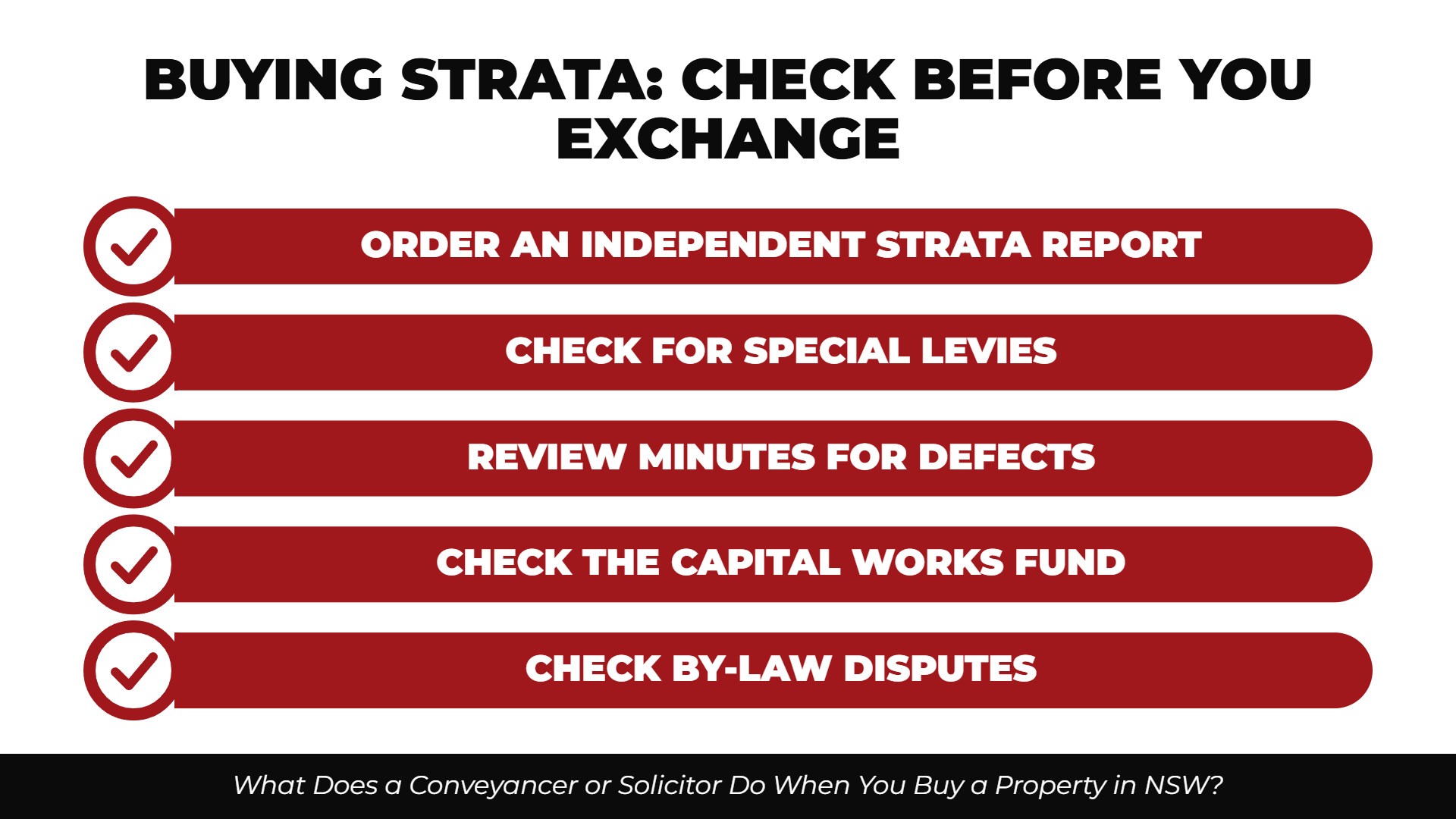
We recommend that every strata buyer orders an independent strata report before exchange, reads the report in full, and directs any questions to the strata inspector who prepared it. Look in particular for:
- special levies, which are one-off charges on top of regular levies, often to pay for major repairs
- building defects raised in meeting minutes
- the balance of the capital works fund (the savings fund for long-term repairs)
- by-law breaches or disputes involving the lot you are buying
- enforcement action by NSW Fair Trading. Since 27 October 2025, Fair Trading has had powers to investigate and enforce the owners corporation’s duty to repair and maintain common property (NSW Fair Trading, Guide to strata law changes). A history of enforcement action is a sign of maintenance problems or disputes.
After exchange, your solicitor usually orders a section 184 certificate from the owners corporation under the Strata Schemes Management Act 2015 (NSW). It confirms the lot’s levies and amounts owing so they can be adjusted at settlement. From 1 April 2026, the certificate must also show (NSW Fair Trading, Guide to strata law changes):
- utilities supplied by an exclusive supply network, for example an embedded electricity network where the building, not you, chooses the supplier
- orders and certain compliance action against the owners corporation, including Fair Trading repair enforcement
- “meetings held in the past year and any upcoming meetings”
Because the certificate usually arrives after you are bound, it is not a substitute for the strata report before exchange.
How much stamp duty will I pay, and when is it due?
Transfer duty (commonly called stamp duty) is a NSW tax on buying property. Revenue NSW states that “Transfer duty is paid by the purchaser or transferee.” The seller does not pay it (Revenue NSW, Who pays and when).
Duty is due on the earlier of:
- the settlement date, or
- three months after signing the contract.
Revenue NSW gives the example of a contract signed on 1 March where settlement was extended to 1 September. Duty was still due on 1 June, three months after signing. If settlement is delayed past three months, you will need the duty funds before settlement. Eligible off-the-plan buyers can defer payment by up to an additional 12 months. That changes when you pay, not how much (Revenue NSW, Who pays and when).
First home buyers
Under the First Home Buyers Assistance Scheme, for contracts exchanged on or after 1 July 2023 (Revenue NSW, First Home Buyers Assistance Scheme):
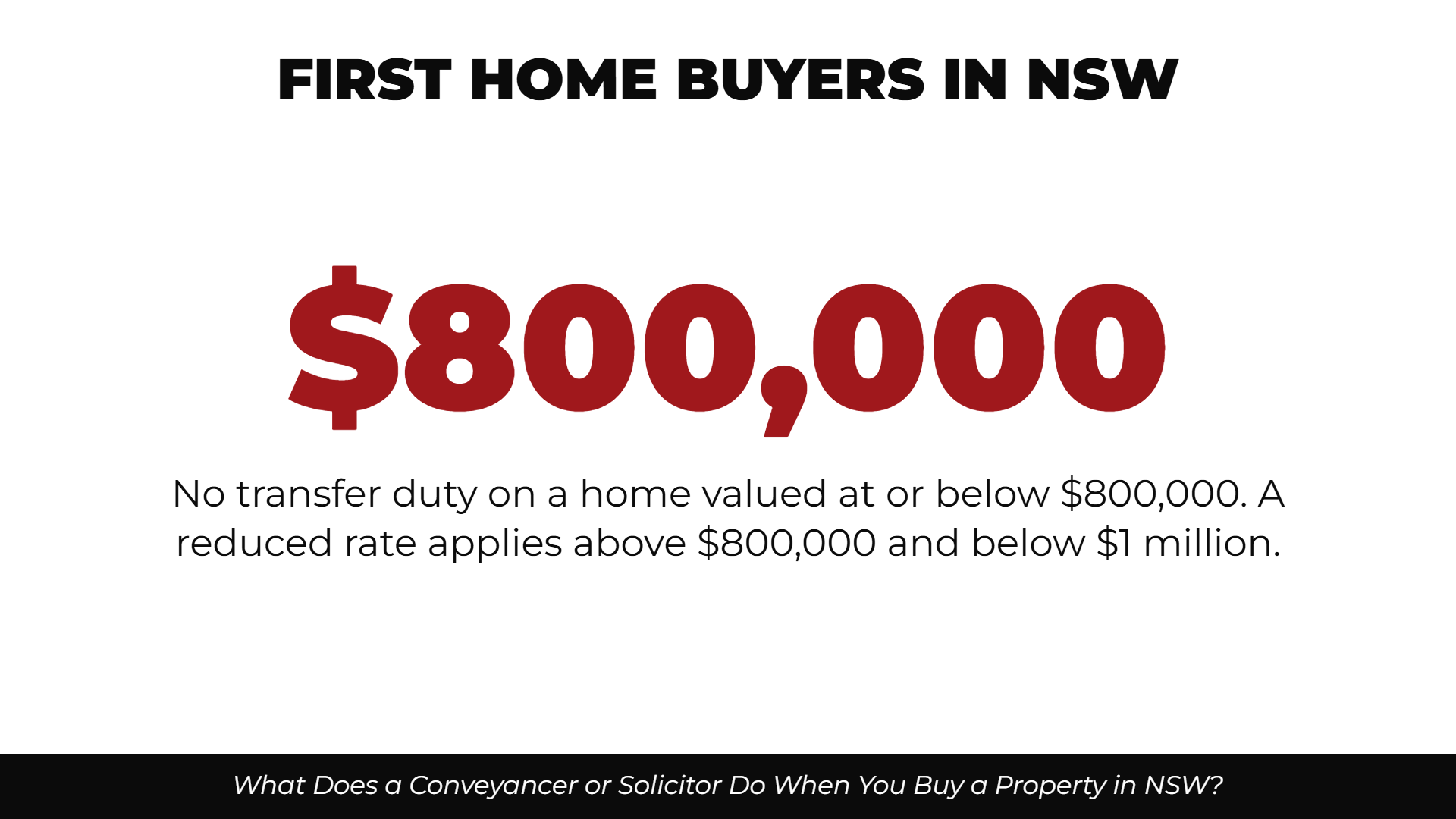
- New and existing homes: no transfer duty for a property valued at or below $800,000, and a concessional (reduced) rate above $800,000 and below $1 million.
- Vacant land to build a home on: no duty up to $350,000, and a concessional rate above $350,000 and below $450,000.
Key conditions include that you and your spouse or partner have never owned residential property in Australia, at least one buyer is an Australian citizen or permanent resident, and for a home you move in within 12 months after settlement and “live in the property as your principal place of residence for at least 12 continuous months” (Revenue NSW, First Home Buyers Assistance Scheme). If you do not meet the residence requirement, the exemption or concession can be reversed.
Your solicitor checks your eligibility before exchange and lodges the duty assessment, so the correct amount is paid on time.
What happens between exchange and settlement?
Exchange is followed by a settlement period, which is set out in the contract. During this time your solicitor works through the steps needed to complete the purchase.
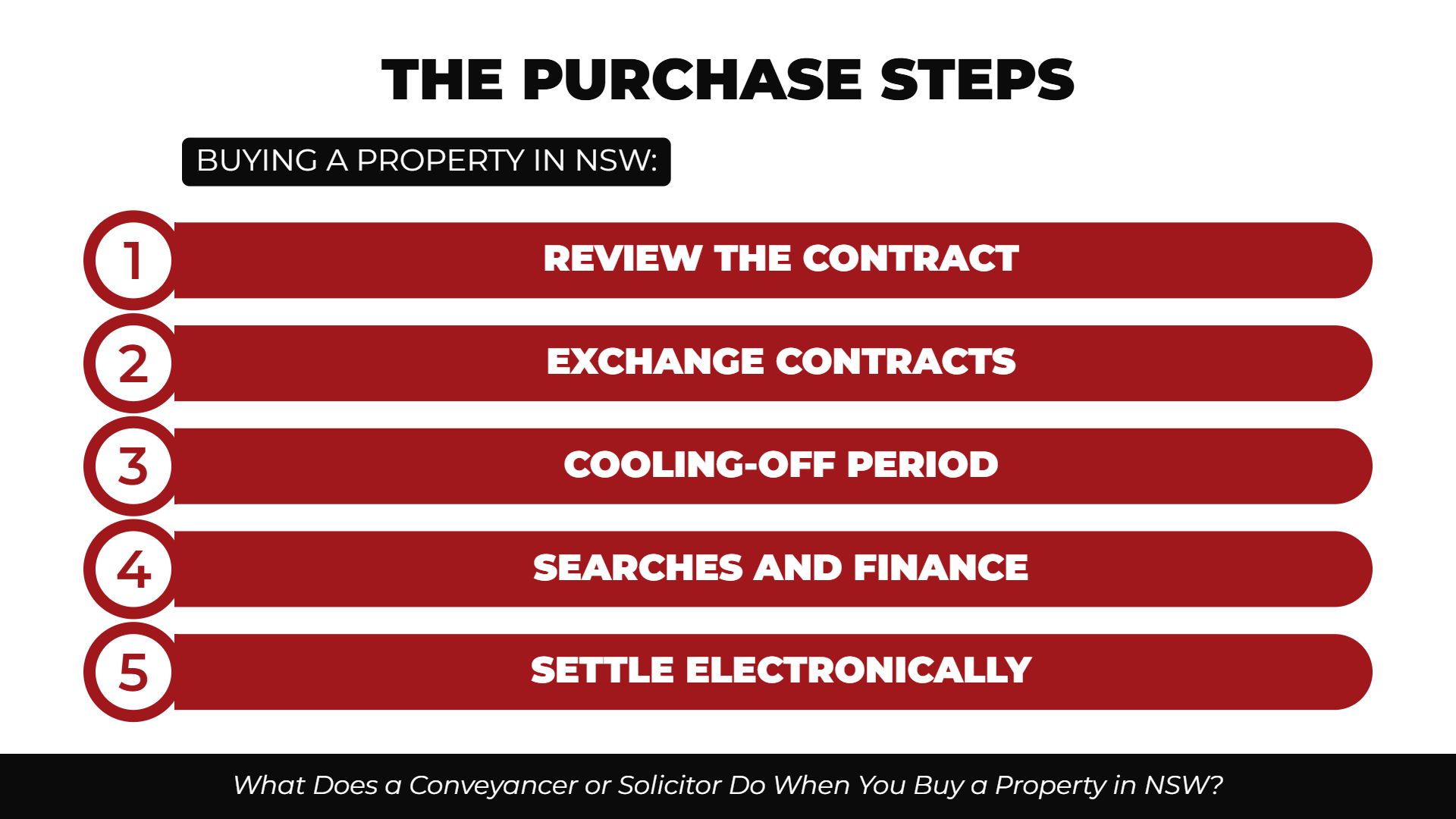
The main tasks are:
- Searches and requisitions. Your solicitor orders searches (for example land tax and council rates certificates, and for strata a section 184 certificate) and sends requisitions on title. Requisitions are formal written questions to the seller’s solicitor about the property and title.
- Finance. Your solicitor works with your lender to arrange the loan documents and mortgage.
- Adjustments. Council rates, water rates and strata levies are divided between you and the seller as at the settlement date.
- Foreign resident capital gains withholding. For contracts from 1 January 2025, a 15% withholding rate “applies to the value of all property.” If the seller does not give a valid ATO clearance certificate by settlement, “the purchaser must withhold an amount” and pay it to the ATO (Australian Taxation Office, Clearance certificates). Most Australian sellers provide the certificate. Your solicitor checks it is valid before settlement.
- Electronic settlement. Since 11 October 2021, all land transactions that require lodgment with NSW Land Registry Services must be completed electronically (NSW Registrar General, eConveyancing). Settlement happens in an online workspace where funds move and the transfer is lodged at the same time.
Why will my solicitor ask for ID and where my money comes from?
From 1 July 2026, lawyers, conveyancers and real estate professionals must comply with Australia’s anti-money laundering and counter-terrorism financing laws, including “conducting customer due diligence” (AUSTRAC, Enrolment for new professions). In practice, your solicitor must verify your identity and may ask about the source of the funds for the purchase. Providing these documents early avoids delays.
What should I do right now?
- Send the contract to a solicitor before you sign anything. This includes an option deed, and any contract you are asked to sign on the day of an auction. Once you exchange without cooling off, or buy at auction, you are bound.
- Do your checks before exchange. Arrange finance approval, a building and pest inspection, and for strata, an independent strata report that you read in full. If the seller wants a 66W certificate, these need to be done first.
- Work out your duty and settlement funds. Confirm whether you qualify for first home buyer relief, and allow for duty being due within three months of signing even if settlement is later.
MLC Lawyers’ conveyancing practice acts for buyers and sellers of homes, apartments, off-the-plan properties and commercial premises, from contract review to settlement. We have offices in Cabramatta and Norwest and act for clients across South West and North West Sydney. Established in 2008, the firm was the 2022 winner of the Australian Small Business Champion Awards for Legal Services.
Our solicitors speak Khmer and Chinese, and interpreters are available for other languages. Contact our Cabramatta or Norwest office through mlclawyers.net, and have the contract, the agent’s details and your expected price ready.
This article is general information about New South Wales law as at November 2026. It is not legal advice and does not create a solicitor-client relationship with MLC Lawyers. For advice about your situation, speak with a solicitor.